Dynamic pacing
Terminology: Aquifer is this implementation; Aqueduct is the implementation-agnostic header protocol (X-Aqueduct-*) it speaks, so other services could speak it too.
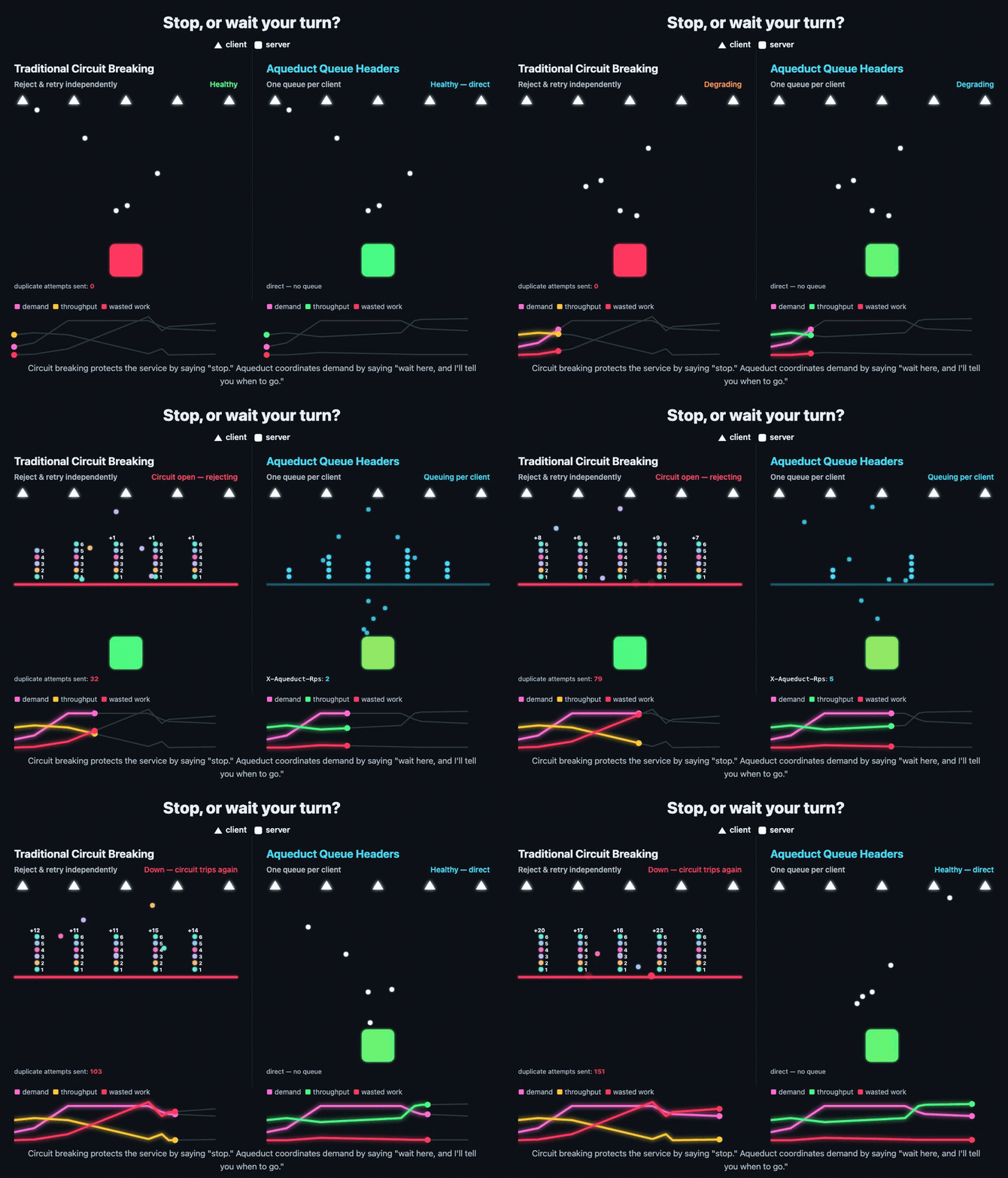
The target API controls pace at runtime via response headers (X-Aqueduct-Rps, X-Aqueduct-Max-Concurrent, and per-tenant queue isolation), and Aquifer honors a lower pace immediately, recovering gradually once pressure clears. For backends that can’t speak Aqueduct directly, Aquifer also reads the real open ORCA standard as a fallback signal: vLLM and Triton/TensorRT-LLM both work today, verified against their actual source.
| Header (preferred) | Alias | Effect |
|---|---|---|
X-Aqueduct-Rps |
X-Aquifer-Rps |
Set this tenant’s rate and share; the highest one advertised is the target’s total |
X-Aqueduct-Max-Concurrent |
X-Aquifer-Max-Concurrent |
Reduce max in-flight requests |
X-Aqueduct-Account-Queue |
X-Aquifer-Account-Queue |
enabled / disabled: one queue per tenant, or one shared queue (has the last say) |
X-Aqueduct-Slow-Start |
X-Aquifer-Slow-Start |
true: new queues ramp up instead of firing at full rate immediately |
X-Aqueduct-Max-Backlog |
X-Aquifer-Max-Backlog |
Set the shared backlog budget used by fair admission |
Aquifer reads both namespaces, preferring X-Aqueduct-* when both are present.
By default each (user_id, api_key) pair gets its own independently paced queue at every target API, so one tenant’s burst, or one tenant’s broken endpoint retrying, can’t slow down another: a failed attempt gives its concurrency slot back and waits out its backoff in that tenant’s own queue.
Who decides, in order:
- The target API. Answering with
X-Aqueduct-Account-Queue: disabled(orfalse) puts everyone sending to it in one shared queue, for example an API that needs one global order.enabled(ortrue) gives everyone their own. Aquifer remembers the choice per target API. - The node owner.
AQUIFER_ACCOUNT_QUEUE=on(the default) oroff. - The origin (whoever sends the job), with the same header on its request, can ask for
enabledwhen the node owner choseoff, but can never turn isolation off. The mode is per target API, so one origin switching it off would take isolation away from every other tenant. Each queue’s pace still stays inside the target API’s actual budget: before dispatching, every tenant queue takes a slot from one shared pace per target API, set to the configuredrps(or a pool’s live capacity), so the target never sees more than that in total, however many tenants are active. The queues still take turns for those slots, so isolation never means an unbounded copy of the full rate per tenant.max_concurrentis still per queue: with N active tenants, up to N ×max_concurrentrequests can be in flight.
When that shared backlog crosses 70% of X-Aqueduct-Max-Backlog, queues holding more than their current fair share receive progressively more 429 responses while smaller queues continue entering, even once the budget is full (up to 125% of it). One active queue can still use the whole budget. See API.md for the formula, response headers, and scope.
Size X-Aqueduct-Max-Backlog in seconds of work, not as a job count. Pick how long Aquifer should be able to hold work for the target API, at least the longest outage you want callers to ride out, and send rate × seconds, where rate is the peak rate jobs for that target API arrive at this node, across all tenants: during an outage, intake fills the budget, not dispatch. The budget is per node. A budget that’s too small turns an outage into a wall of 429s: in the Hatchet outage benchmark, a 60-second budget at 20 rps (1,200 jobs) meant a 5-minute database outage refused about 25,000 submissions, and small tenants’ recovery p99 was 107 s, against 3.8 s behind Envoy. A 600-second budget let the same small tenants through with no refusals at all, at a 5.5 s p99. If the advertised rate falls during an outage, keep the budget from falling with it below what Aquifer already holds; otherwise every queue is over budget at once.
A backend can lower RPS at any time via these headers when it’s under pressure; Aquifer honors the lower pace immediately and recovers gradually toward the configured ceiling once pressure clears.
With X-Aqueduct-Slow-Start: true, a new queue starts at a low floor rate instead of its full configured rate and climbs toward that ceiling using the same gradual-recovery mechanism above, rather than firing at full speed from its very first dispatch. This applies per domain: since a queue’s first-ever dispatch has no prior response to read the signal from, the setting takes effect on the next new queue created for that domain once any response has carried it, not the request that carried the header itself, and not retroactively for queues already running.
Use the pacing headers for intentional backpressure. A 5xx response is treated as a failed dispatch attempt and, for pool members, lowers that member’s reputation. If a service is alive but overloaded, prefer 429 and/or X-Aqueduct-Rps / X-Aqueduct-Max-Concurrent so Aquifer slows down without interpreting the member as broken.
ORCA fallback for backends that can’t speak Aqueduct directly. Some backends already report load in a different, real open standard: ORCA (Open Request Cost Aggregation), the gRPC/Envoy ecosystem’s convention for backends to report utilization. Aquifer sends endpoint-load-metrics-format: text on every dispatch (the request-side opt-in both verified backends require; there’s no server startup flag for this), and a backend that understands it replies with an endpoint-load-metrics header carrying a KV-cache utilization fraction. If a response carries no X-Aqueduct-Rps/X-Aquifer-Rps, Aquifer reads this header as a fallback and paces down as utilization rises: full configured rate below 70%, 2 RPS at 70-90%, 0.5 RPS at 90-97%, 0.25 RPS above that, never dropping to zero, same pacing-down-gracefully philosophy as everywhere else. An explicit X-Aqueduct-Rps always wins if present; this only fires when the backend hasn’t opted into speaking Aqueduct’s own headers.
Two backends verified directly against their own source, not assumed: vLLM (vllm/entrypoints/serve/utils/orca_metrics.py, metric name kv_cache_usage_perc, case-insensitive opt-in) and Triton/TensorRT-LLM (src/orca_http.cc, metric name kv_cache_utilization, case-sensitive lowercase-only opt-in; Aquifer sends lowercase specifically so both work). Aquifer tries both known metric names, so whichever backend you’re running, this works without any configuration.
Dynamic priority
Section titled “Dynamic priority”Most queues that support priority read it from a static file: a tier per customer, or a list of user IDs that go first. That works until the important user changes faster than someone can edit the file. Aquifer has no priority setting. Every tenant takes equal turns until the target says otherwise, and the target says otherwise on any response, with the same X-Aqueduct-Rps header it already uses to set its pace.
The target sets its total. A target’s queues together never go past the highest X-Aqueduct-Rps it is currently advertising to any active tenant (one that dispatched in the last 3 seconds). The configured rate applies only while it advertises nothing, so a backend can run faster or slower than its config on headers alone. A backend that stamps one number on every response gets that number in total, not per tenant. A pool’s total is its live capacity, which its members advertise.
It sets each tenant’s share the same way. When several tenants are backlogged, the total is split in proportion to the rate the target last sent each one. Advertise 600 to one tenant, 60 to a second and 6 to a third, and the total is 600/s, split 90%, 9% and 1%. Tenants advertised the same rate take equal turns. A tenant that has never been sent a rate, or whose last one a failure cleared, is weighted by its own current pace instead, which failures halve and slow start lowers, so with no headers at all, healthy tenants take equal turns and a failing one takes fewer. Rates have a floor of 0.5 requests a second, per tenant and in total: a target advertising less still gets 0.5, so a struggling target always sees enough traffic to show it has recovered. A tenant that asks for less than its share keeps its own pace, and the rest goes to the others.
That allows deliberately unfair processing when it matters. Fair turns are the right default, but some moments aren’t fair:
- A flood warning goes out and one county’s alert jobs have to reach phones before anything else does.
- A security team is responding to a breach, and its log queries and key rotations can’t wait behind routine scans.
- A hospital’s monitoring alerts arrive during a surge, and a patient’s alert can’t sit behind billing exports.
In each case the backend already knows which tenant is in trouble, often before any human does. It advertises that tenant a much higher rate, say 1000 next to 10 for each of ten others, and from the next response on that tenant gets 1000/1100 of the target, about 91%, while everyone else slows down but keeps moving. When the emergency ends, the backend advertises that tenant its normal rate again: from its next response the turns are back to normal, and the total falls to the highest rate still advertised. Send the lower rate rather than dropping the header, because an advertised rate stays in force until the target sends a new one or a failure clears it; a response without the header keeps it. A tenant that goes idle stops counting toward the total after 3 seconds. Nothing was configured, and nobody had to deploy anything.
A real recovery, done by hand. On May 20, 2026, Railway was recovering a backed-up build queue after a cloud outage. To keep paid builds moving, they paused free, trial and hobby builds, resumed them, and repeated that four times over about ten hours, while a hobby customer called it unfair (status page). With Aquifer, the build service would advertise a high rate to paid workspaces and a low one to the rest, raising it as the backlog drained until every workspace was back to equal turns, with no switches to flip and no one watching.
The rate a client submits never counts: only the target’s responses can set pace or priority, so a tenant can’t make itself the emergency.
More than one node
Section titled “More than one node”Nodes don’t coordinate, so each one applies the rates it’s sent on its own: three nodes each advertised 20 send up to 60/s in total. To hold the whole cluster to a budget, the target divides it by the number of nodes sending to it, counting the distinct X-Aqueduct-Node-Id values it has seen in the last few seconds, and scales every rate it advertises by that share: a budget of 20/s across three nodes means advertising each node’s top tenant 6.7, with the others in proportion. When a node comes online the count goes up and every node slows down on its next response; when one crashes its id stops arriving, and the rest speed back up. The split is even, so a node with little work leaves part of its share unused. Three things keep the count honest:
- Each node needs its own
AQUIFER_NODE_ID(by default the Fly machine id or host name). Nodes sharing an id count as one and each send the whole budget. - Count ids only from Aquifer nodes you trust, over a private network or authenticated requests; otherwise a caller could forge ids and push your real nodes’ rates down.
- A new rate reaches each queue on its next response, and a node that hasn’t been sent one runs at its configured rate. So the total can briefly overshoot after a node joins or restarts; set configured rates to the per-node share, and put a limiter in front of the target if the budget must never be exceeded.